


Now it's time for Defense? US Missile Stocks Are Running Low: The Next Defense Trade Is Restocking
Defense stocks have already rallied on higher budgets, Europe rearmament, drones and missile defense.$RTX Corp(RTX)$$Lockheed Martin(LMT)$$Northrop Grumman(NOC)$$Boeing(BA)$
The next theme may be simpler: the US needs to rebuild missile inventories.
Recent conflicts have turned a long-known production gap into an urgent supply problem. Citrini Research notes that US missile and interceptor use over a five-month period exceeded any full year since the Gulf War.
Air defense is the clearest case.
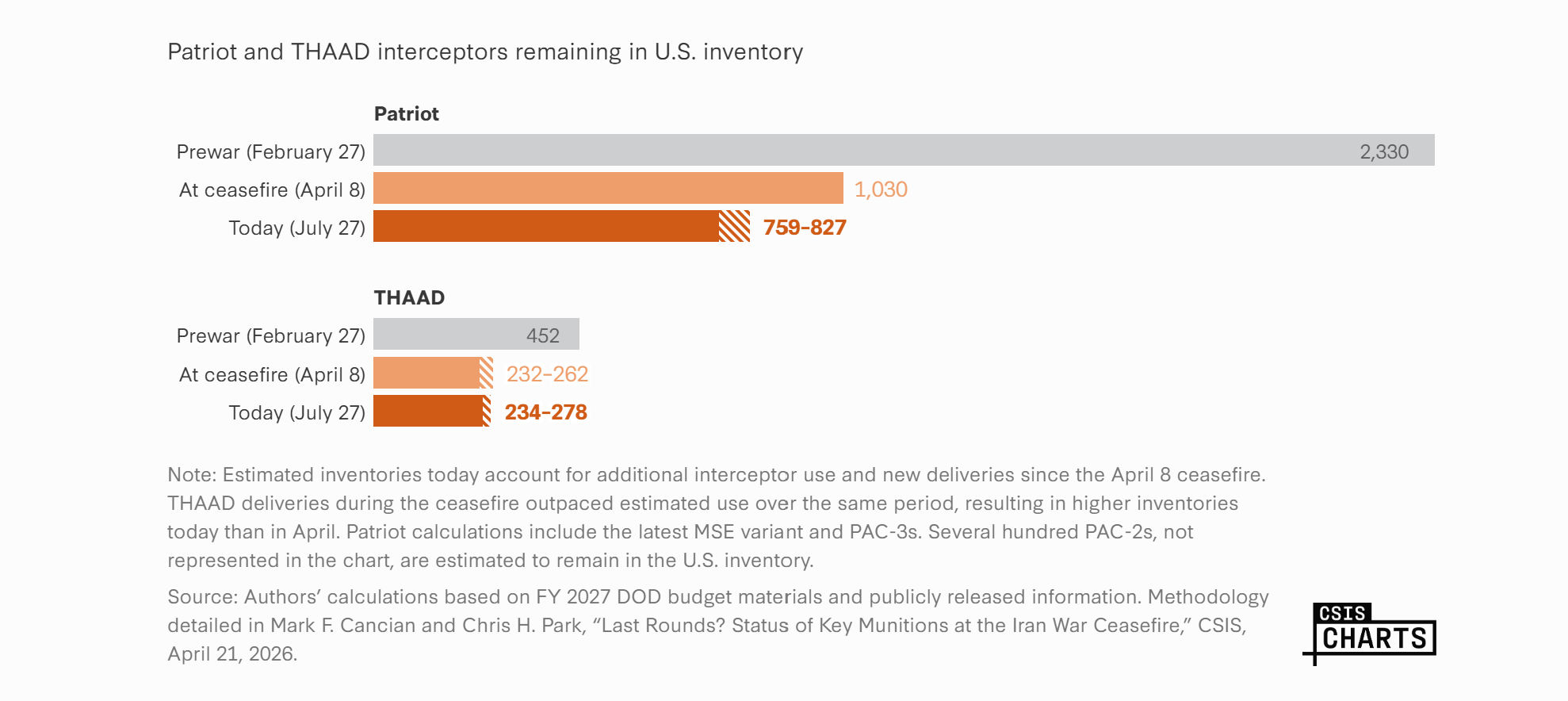
CSIS estimates the Iran conflict consumed about 65% of pre-war US Patriot interceptor stocks, while THAAD inventories also fell sharply. Patriot matters because few mature systems can replace it against tactical ballistic missiles.
The issue is not just cost.
A PAC-3 MSE interceptor costs roughly $4–5 million, but supply is the bigger constraint. Missiles depend on rocket motors, seekers, radar parts, electronics, propellants and specialist materials. New capacity can take years.
More budget today does not mean more missiles tomorrow.
That is now showing up in procurement.
The FY2027 US budget sharply raises missile-defense and strike spending. Congressional Research Service data puts related procurement and R&D requests at about $82.2 billion, while broader Missile Defense and Defeat funding approaches $85 billion.
Procurement terms are also changing.
Defense firms have historically avoided major capacity expansion without long-term demand visibility. After the post-Cold War drawdown, the industry consolidated and kept spare capacity low.
The Pentagon is now pushing faster expansion through multi-year orders, minimum purchase commitments and government-backed factory investment.
That matters for investors.
Past defense trades were driven mainly by higher budgets and geopolitical risk. This cycle increasingly has a physical constraint: missile inventories are too low.
Three areas stand out.
First, mature missile and interceptor systems such as Patriot, THAAD, Standard Missile, Tomahawk and PrSM. Rebuilding stocks usually starts with weapons already deployed and qualified.
Second, the supply chain.
Prime contractors such as Lockheed Martin and RTX benefit, but production can be limited by rocket motors, propellants, guidance systems, RF components and specialty materials. Some suppliers may see stronger operating leverage than the primes.
Third, cheaper interception.
Using multi-million-dollar missiles against drones costing tens or hundreds of thousands of dollars is hard to sustain. That should support more spending on counter-UAS, electronic warfare, low-cost interceptors, directed energy and lasers.
The FY2027 Golden Dome plan already includes high-power laser systems.
This also means defense stocks should become more selective.
A broad “defense spending rises, buy everything” trade is less attractive after strong gains in many names.
The key questions now are more specific:
Are orders becoming multi-year contracts? How fast is capacity rising? Which components are bottlenecks? How much new Capex converts into revenue?
Defense revenue takes time to ramp, but long-term government commitments can also create unusually strong visibility.
The core issue is clear: Patriot, THAAD and several long-range strike inventories are being consumed faster than they can be replaced.
So the defense cycle may still have room to run.
The next phase is less about how much governments spend and more about who can build missiles fastest.
Disclaimer: Investing carries risk. This is not financial advice. The above content should not be regarded as an offer, recommendation, or solicitation on acquiring or disposing of any financial products, any associated discussions, comments, or posts by author or other users should not be considered as such either. It is solely for general information purpose only, which does not consider your own investment objectives, financial situations or needs. TTM assumes no responsibility or warranty for the accuracy and completeness of the information, investors should do their own research and may seek professional advice before investing.
